
Our Unique Sense of Place
The Architecture Around Us
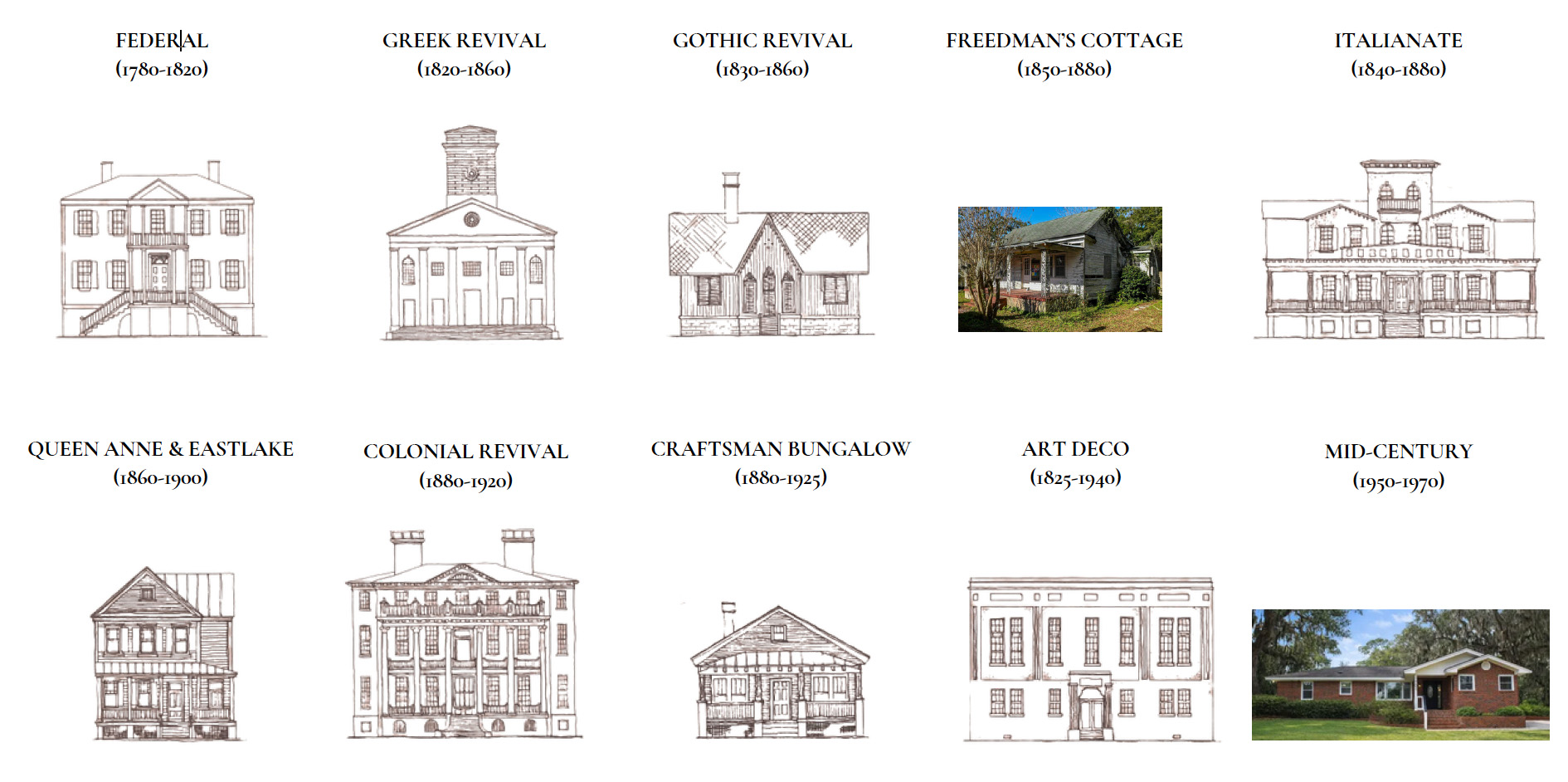
Historic Beaufort Foundation works to preserve the full spectrum of Beaufort’s architectural heritage across all historic neighborhoods, from the grand pre-Civil War homes found on The Point, to the Reconstruction-era developments of the Northwest Quadrant and the vernacular structures of the Old Commons. Our preservation efforts recognize that every neighborhood contributes to Beaufort’s unique sense of place and tells an essential part of the community’s story. The recent expansion of the period of significance to include 1970s structures acknowledges the important contributions of mid-century modern architecture to Beaufort’s environment. Whether Colonial, Federal, Victorian, or Craftsman, each architectural style represents a chapter in Beaufort’s 300-year history and deserves protection for future generations to learn from and appreciate.
What is the Beaufort Style?
The “Beaufort Style” is a distinctive regional architectural form characterized by a T-shaped floor plan with two-story piazzas (porches) spanning the front facade, elevated high off the ground on tabby or brick foundations. this design evolved as a practical response to the Lowcountry’s subtropical environment, with the raised elevation capturing cooling breezes while protecting against flooding and dampness, and the deep piazzas providing essential shade and outdoor living space. The T-form configuration places the main living spaces perpendicular to the street, maximizing cross ventilation and privacy while the piazzas face South to capture the prevailing winds. Found throughout Beaufort’s historic district from the late 18 century through the 19 century, this vernacular style represents and ingenious adaption to coastal living that defines Beaufort’s architectural character.
Tabby: The Foundation of the Lowcountry
Tabby was an important local building material used primarily throughout the 18 and early 19 centuries along the coastal South. This distinctive construction material was perfectly suited to our region because all of its components were readily available: oyster shells, sand, and lime (created through burning oyster shells).
Creating tabby was a labor-intensive process that required skill and patience. First, oyster shells were collected, crushed, and burned in kilns to produce lime. This lime was then mixed with sand, water, and larger oyster shell fragments to create a concrete-like aggregate. The mixture was poured into wooden forms and allowed to cure and harden, creating durable walls that could last for centuries.
Colonel Thomas Talbird was recognized as one of Beaufort’s most skilled tabby builders. His expertise helped construct numerous buildings throughout the area, including houses, stores, churches, and outbuildings. Talbird died in 1806, and many historians believe his death marked the end of tabby construction in the region.
While tabby was most commonly used as foundation materials – as seen in the ca. 1804 John Mark Verdier House, Beaufort is home to three remarkable structures built entirely of tabby: the Barnwell-Gough House, Tabby Manse, and the Captain Francis Saltus House. The Saltus House holds particular significance, as some historians consider it the only surviving three-story tabby structure in America.
A circa 1800 tabby garden or yard wall located on the North side of the 800 block of Bay Street (behind Modern Jewelers at 807 Bay Street) still stands and is visible from the Scott Street parking lot